
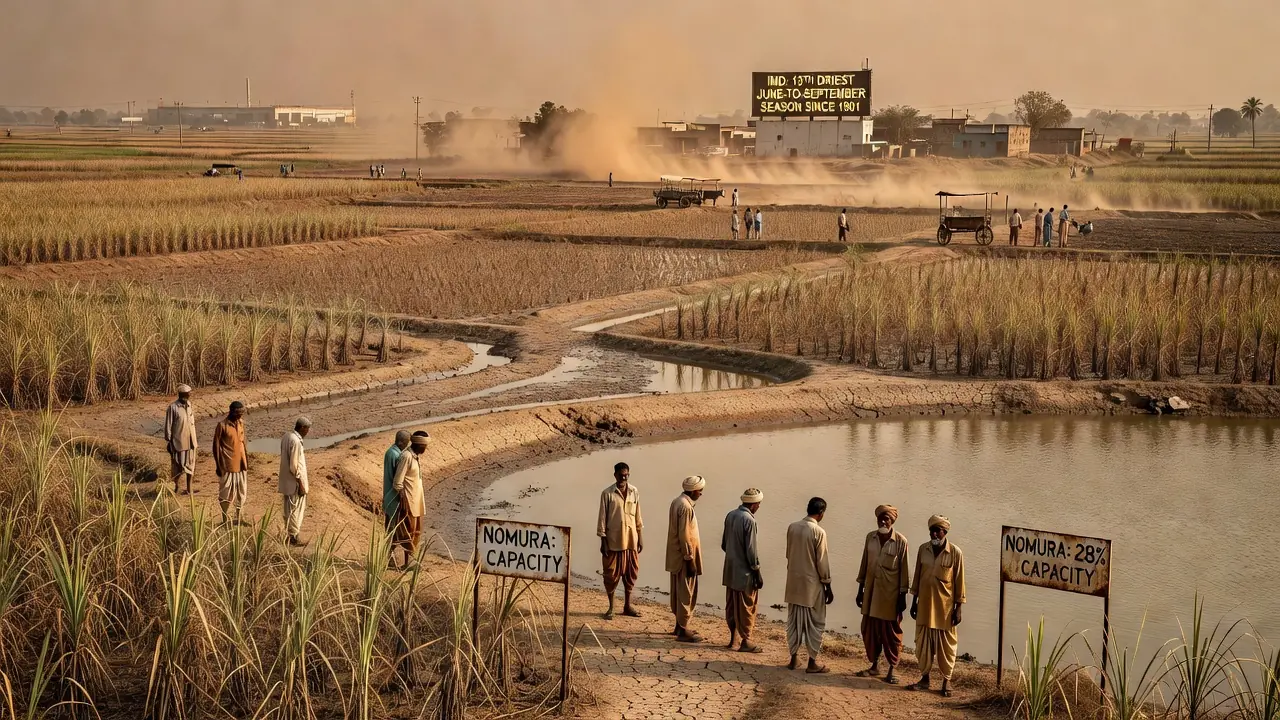
India's weather has turned into an economic problem. A season of poor monsoon rainfall, among the weakest in more than two decades, is compounding pressures already building on Asia's fastest-growing major economy - from costlier energy imports to jittery foreign investors pulling money out of its stock market.
The numbers from the June-to-September monsoon, the period that waters most of India's farmland and fills its reservoirs, are stark. The India Meteorological Department recorded the 13th driest season since 1901 and the fourth lowest since 2001. By late September, reservoirs sat 28% below full capacity, according to Nomura, with states including Maharashtra, Andhra Pradesh, Punjab, and Haryana reporting extreme drought conditions.
Why a Bad Monsoon Hits the Whole Economy
Agriculture makes up a relatively modest slice of India's GDP, roughly 17%, but it employs close to half the country's workforce. That imbalance is the crux of the problem. When harvests shrink, rural incomes fall immediately, even as the broader economy might still post healthy growth on paper. Rural households spend differently than urban ones, and nearly 40% of fast-moving consumer goods sales - toothpaste, soap, packaged food - happen outside cities, according to Nielsen Consumer data. That makes weak harvests a direct threat to demand for companies like Hindustan Unilever, Nestle India, and automakers Maruti Suzuki and Hyundai, all of whom depend on rural buyers.
The sugar sector illustrates the mechanism well. India is the world's second-largest producer of sugarcane, an industry that supports an estimated 5 crore farmers and 5 lakh factory workers. Weak monsoons and dry spells reduce both yields and sucrose content, squeezing incomes across a supply chain that stretches from smallholder farms to processing plants.
Inflation, Fertilizer Shortages, and a Warning From Delhi
Food price pressure is already visible. Inflation has climbed for ten consecutive months and pushed past the Reserve Bank of India's medium-term 4% target in August. Foreign Minister Subrahmanyam Jaishankar, speaking at an Asia Society event in New York, pointed to a second compounding factor: fertilizer shortages tied to geopolitical disruption in major producing regions including the Middle East and Russia. Combined with the El Niño pattern, he warned, the coming months could bring "a major food crisis." Opposition politicians in India seized on the remarks to accuse the government of being slow to prepare.
The World Bank's latest assessment echoes the concern, noting the monsoon shortfall looks worse than initially projected and will likely dent agricultural output and rural demand while pushing food inflation higher, on top of existing energy-price pressure.
What Analysts Expect Next
Forecasts for farm-sector growth have been revised down. Morgan Stanley expects the gross value added by agriculture to grow just 1.6% in the financial year ending March 2027, a sharp slowdown from the 3.5% average of the past three years. S&P Global Market Intelligence puts the figure slightly higher, at 1.9%. Hanna Luchnikava-Schorsch, the firm's head of Asia-Pacific economics, told CNBC that stress indicators are already surfacing - slower tractor sales and rising demand for rural employment support schemes among them - even as headline economic data has held up so far.
- Lowest monsoon rainfall in over a decade, the 13th driest since 1901
- Reservoirs 28% below capacity at season's end, per Nomura
- Food inflation rising amid parallel fertilizer shortages
- Rural demand slowdown projected into 2026 and 2027
A Regional Risk, Not Just a National One
Risk advisory firm Verisk Maplecroft frames this as a wider South and Southeast Asian problem. It lists India alongside Indonesia, Pakistan, Bangladesh, and the Philippines as economies most exposed to El Niño-driven food insecurity - and most vulnerable to civil unrest should prices keep climbing. For India specifically, the test will be whether existing policy tools, from grain stockpiles to rural employment guarantees, can cushion the blow before frustration translates into something harder to manage politically.