
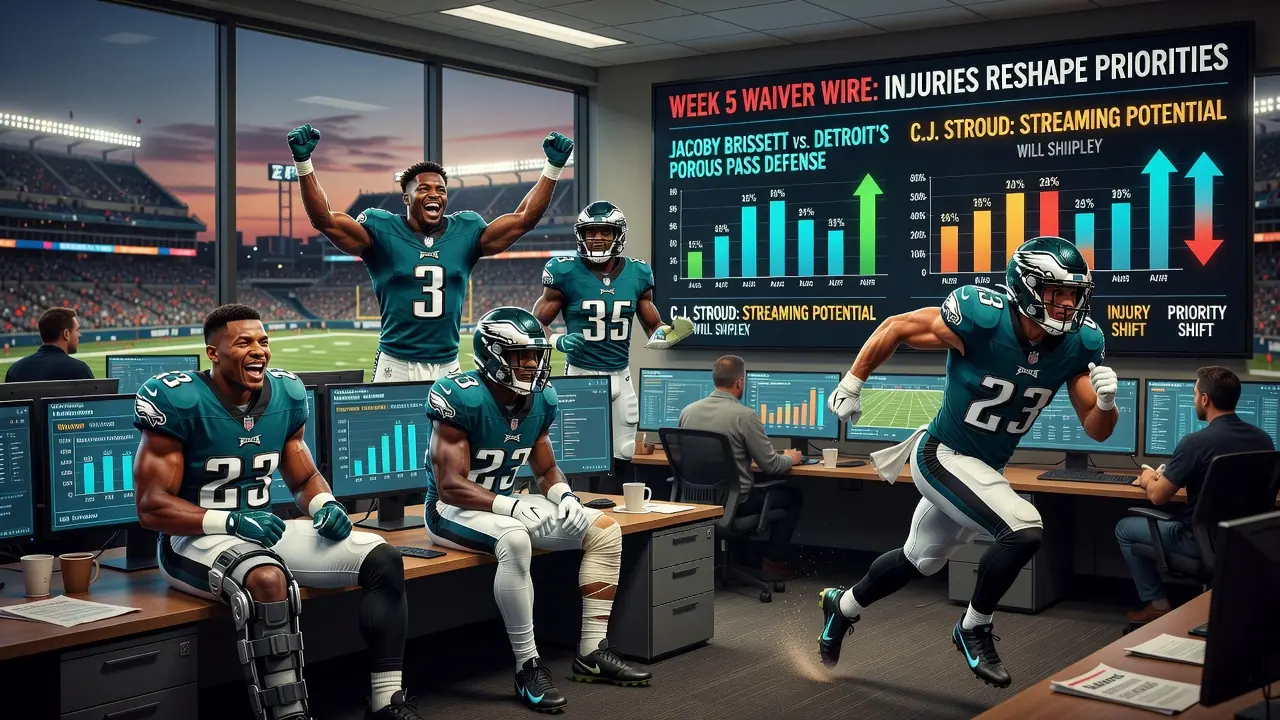
Fantasy football managers are navigating one of the most injury-disrupted stretches in recent memory, and Week 5 brings no relief. With Saquon Barkley and Tank Bigsby among the casualties from Week 4, along with bye weeks for the Chiefs and Panthers, roster depth has become the deciding factor in league standings. The waiver wire this week is thin on obvious impact plays but rich in opportunity for managers willing to read matchups and depth charts closely.
Replacement-Level Value Driven by Attrition
The running back landscape illustrates how quickly value shifts when a starter goes down. Philadelphia's Will Shipley stands out as the clearest beneficiary, positioned for a larger role regardless of Barkley's exact outlook. In Seattle, the picture is murkier: Emanuel Wilson's strong outing and Zach Charbonnet's re-opened practice window both carry weight, but the team's decision to add Joe Mixon to the practice squad complicates any confident long-term read. This is the nature of handcuff speculation - useful in the short term, risky as a season-long investment.
At quarterback, the waiver pool skews toward matchup-based streaming rather than true difference-makers. Detroit's pass defense has been porous enough to make Jacoby Brissett a viable one-week option, while C.J. Stroud and Jameis Winston offer similar matchup upside against vulnerable secondaries. None of these represent sustainable weekly starters - they are tactical plays tied to specific opposing defenses, and managers should treat them accordingly rather than assuming repeatable production.
Separating Genuine Breakouts From Small-Sample Noise
Wide receiver remains the position where distinguishing signal from noise matters most. Denzel Boston and K.C. Concepcion have earned real roster consideration based on expanding roles within a productive passing offense, not a single explosive outing. By contrast, a two-catch, two-touchdown performance - the kind Darius Cooper produced - is a textbook example of fool's gold: efficient but unsustainable given the surrounding offensive context. Romeo Doubs falls somewhere in between, a player whose breakout game may reflect quarterback improvement as much as individual opportunity.
Tight end continues to be the position of least certainty across fantasy formats generally, and this week is no exception. Mike Gesicki's added value depends heavily on whether Cincinnati's top receivers can play, underscoring how tight end production often hinges on circumstances outside a player's own performance.
Why Roster Percentage Context Matters
League format shapes what's actually available far more than any single list can capture. A 10-team league with six bench spots has a dramatically deeper free-agent pool than a 14-team league with eight bench spots, which is why blanket roster-percentage thresholds are an imperfect guide at best. Managers should treat waiver recommendations as a starting point for their own league's depth chart, not a universal prescription - the same player can be irrelevant in one league and a league-winner in another, depending purely on scarcity.