
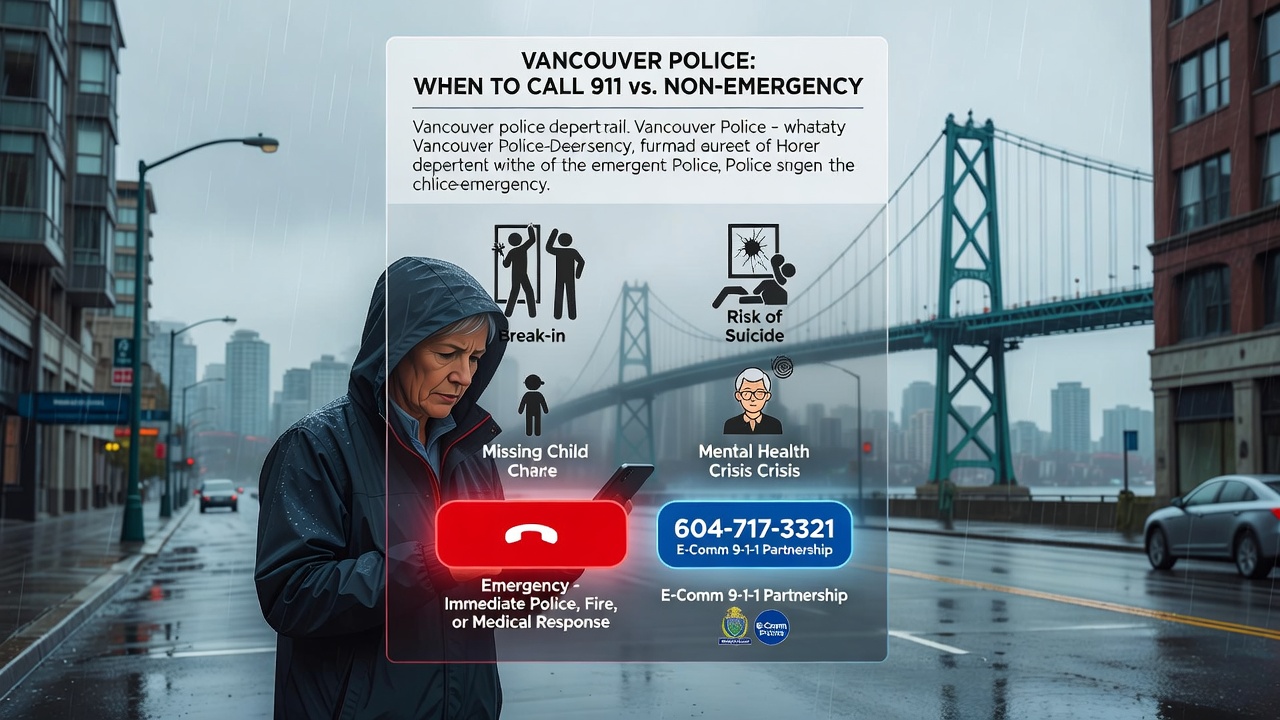
Dialling the right number can shape how quickly help arrives. The Vancouver Police Department, working with its contracted call-answer partner E-Comm 9-1-1, has laid out clear guidance on when residents should call 911 and when the non-emergency line at 604-717-3321 is the better option. The distinction matters because emergency systems are built for speed, and routing non-urgent matters through them can slow response times for genuine crises.
What Counts as an Emergency
911 exists for situations demanding an immediate police, fire, or medical response: a crime in progress, a threat to life, or an unfolding public safety risk. Dispatchers who answer 911 calls are trained to triage quickly, which depends on callers understanding what qualifies. Reporting a break-in as it happens, witnessing graffiti being sprayed, or facing an incident involving a person at risk of suicide all fall into this category. The VPD is explicit that missing-person reports involving children, seniors, people with mental or physical challenges, or anyone believed to be suicidal should also go through 911, since there is no mandatory waiting period to report someone missing in British Columbia.
The Role of the Non-Emergency Line
Many incidents are serious but not time-critical. A break-and-enter discovered after the fact, an assault reported the next day, or a noisy party call through the 604-717-3321 line rather than 911. The VPD also allows certain low-risk crimes to be reported online when there is no suspect and no violence involved, including:
- Lost or stolen property valued under $25,000
- Vandalism to property or a vehicle where repair costs are expected to stay under $25,000
- Vehicle break-ins
This tiered system reflects a broader principle in emergency services management: resources are finite, and misdirected urgency has real costs. A 911 line tied up with a report that could wait diverts attention from calls where minutes matter.
Accessibility and Specialized Support
Text with 9-1-1 (T911) allows people who are Deaf, deafened, hard of hearing, or have a speech impairment to communicate with call centres through text messaging during an emergency. The service requires registration in advance; a text sent to 911 from an unregistered phone, or without an accompanying voice call, will not be received. This is a meaningful limitation for anyone relying on the service, and it underscores why residents who may need T911 should confirm their registration status before an emergency occurs rather than during one. The VPD also maintains civilian Victim Services staff trained in crisis intervention and trauma-informed support for people affected by relationship violence, which can include intimidation, financial control, or psychological abuse as well as physical harm.
Beyond Policing: Fraud, Property, and Other Reports
Not every call to police is the right channel. Fraud without financial loss goes to the Canadian Anti-Fraud Centre, while fraud losses in Vancouver exceeding $10,000 warrant a police report. Vehicle collisions without injury or imminent danger are handled through ICBC. Parking enforcement, graffiti on City property, illegal dumping, and landlord-tenant disputes each have their own reporting paths outside the police non-emergency system. The VPD's Property Office also manages found items, with unclaimed property held for 90 days before disposal through public auction, a detail that matters for anyone who has lost belongings in the city. Anonymous tips, meanwhile, can go through Crime Stoppers rather than the non-emergency line, preserving confidentiality for people reluctant to identify themselves to police directly.