
UK Government Builds In-House System to Support Ukraine Housing Scheme
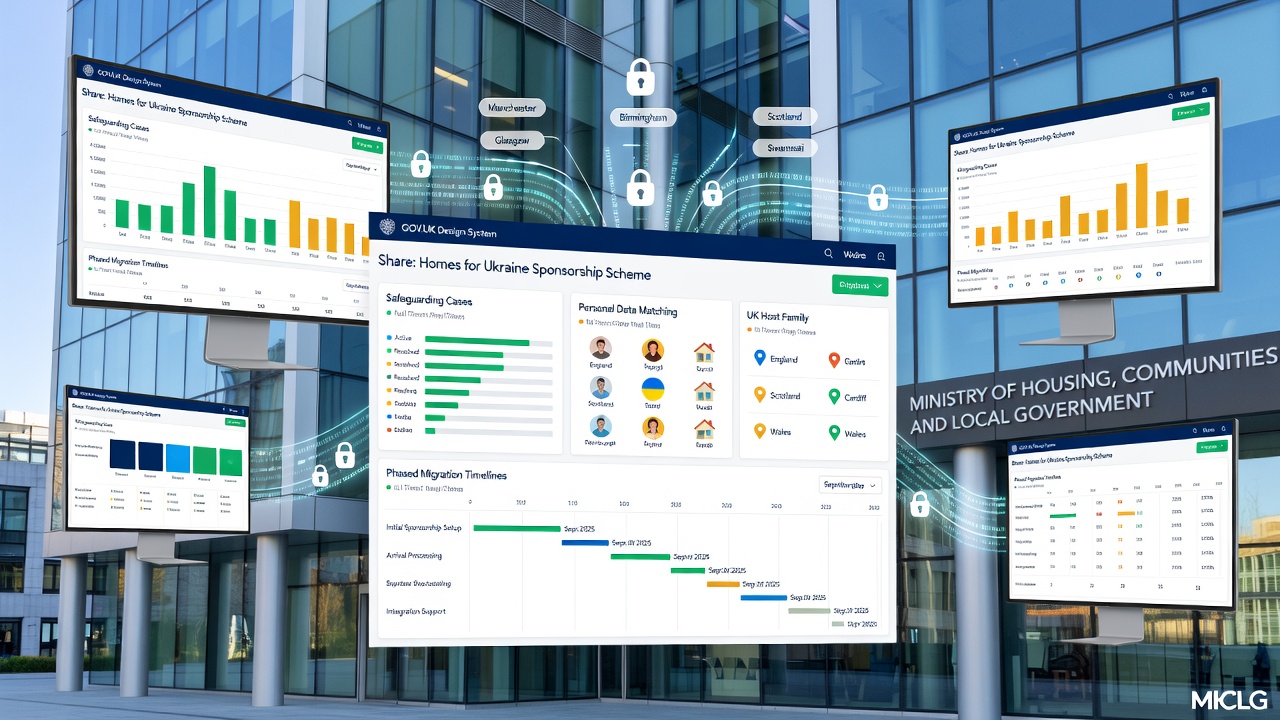
A government team has quietly completed one of the more unusual digital transformation projects in recent public sector history: replacing a supplier-run platform underpinning a wartime housing programme with a system built entirely in-house. The Homes for Ukraine Sponsorship Scheme, launched in 2022 to match Ukrainians fleeing Russia's invasion with UK hosts, depended from the outset on a data platform managed by an external supplier. In September 2025, the Ministry of Housing, Communities and Local Government (MHCLG) switched that platform off for good, replacing it with a new system called Share.
Why the switch mattered
Emergency government services are typically built fast, using whatever technology is available, because speed saves lives and reduces harm. That was true of the original Homes for Ukraine platform, stood up under extreme pressure in 2022. But systems designed for crisis response often carry long-term costs: vendor lock-in, limited control over code and data, and running costs that stay high long after the initial emergency has passed. MHCLG's decision to build Share in-house reflects a broader pattern across government digital services, where departments increasingly weigh the short-term convenience of supplier platforms against the long-term value of owning their own technology and data.
Handling sensitive data under pressure
Share is not a simple database. It manages safeguarding information and personal data covering individuals who have fled conflict, shared between central government, local authorities and devolved administrations. That combination - sensitive subject matter, multiple institutional users, and a live service that could not simply be paused - created real constraints on how the migration could happen. The team's answer was a phased data migration with repeated rounds of quality assurance, moving three years of operational data without breaking continuity for the local authorities relying on it daily.
Design choices under a tight deadline
Building government services well usually requires extensive user research. The Share team had less than a year and limited direct access to its primary users, so it worked with what already existed: three years of accumulated research from running Homes for Ukraine, and the GOV.UK Design System, a well-tested, accessible-by-default framework used widely across government services. That let the team concentrate its research effort on the most complex parts of the system rather than rebuilding foundational design knowledge from scratch - a pragmatic trade-off rather than a shortcut.
What this means beyond one scheme
The immediate outcome is a functioning system that local authority users describe as easier to navigate than its predecessor, with clearer visibility of outstanding safeguarding cases. MHCLG expects the change to save millions of pounds annually in running costs, and is preparing to bring local authorities in Scotland and Wales - previously operating separate systems - onto the same platform, reducing duplication across the public sector. The department is also exploring whether Share's underlying architecture could be reused for other government services facing similar data-sharing challenges, which would extend the value of the investment well beyond its original purpose.
- Share replaced a supplier-owned platform in September 2025, ending that contract
- Three years of operational data were migrated using a phased, quality-assured approach
- MHCLG is preparing to onboard local authorities in Scotland and Wales
- A live service assessment is planned to benchmark Share against government service standards
The project's significance lies less in the technology itself than in what it demonstrates: that a complex, high-sensitivity public service can be moved from external supplier dependency into sustainable in-house ownership without disrupting the people who rely on it. For a government that increasingly weighs the cost and control trade-offs of outsourced digital infrastructure, that precedent may prove as valuable as the system itself.