
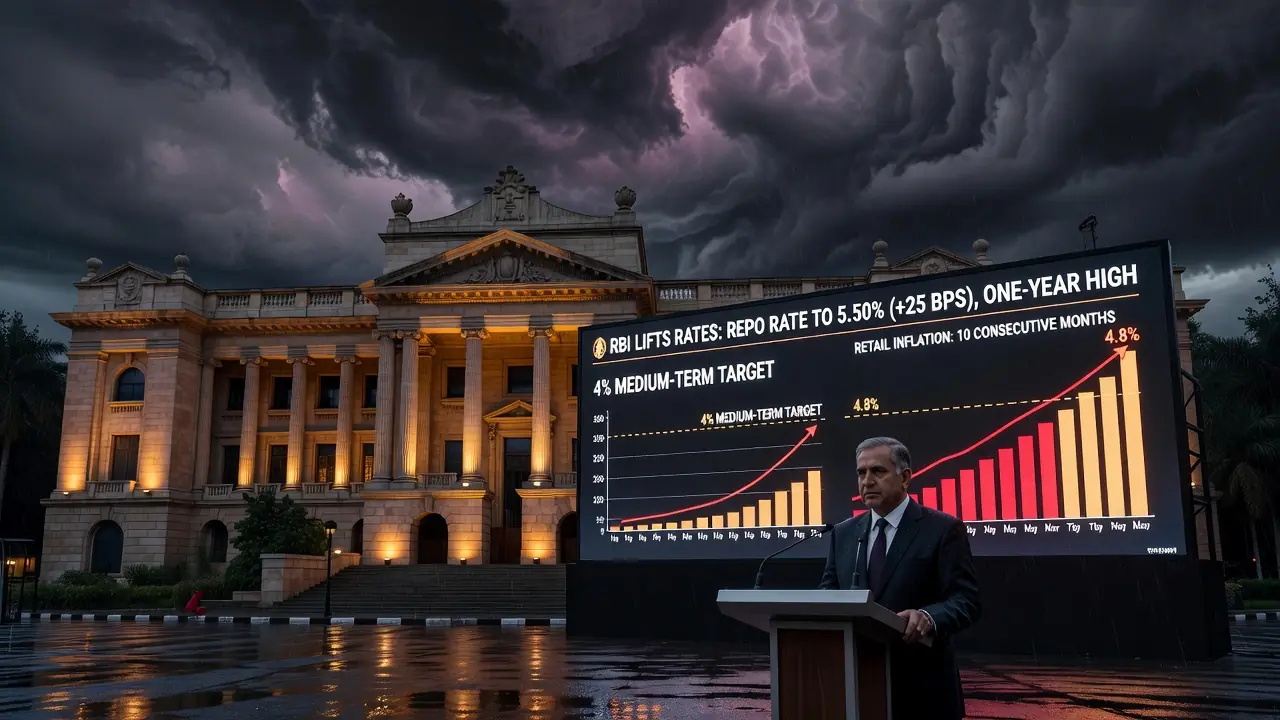
India's central bank ended more than two years of steady policy on Wednesday, raising its benchmark repo rate by 25 basis points to 5.50%, a one-year high. The move puts the Reserve Bank of India alongside a growing list of major central banks moving to tighten monetary policy as inflation proves more persistent than expected.
RBI Governor Sanjay Malhotra said the decision reflected a shift in the committee's outlook. "Inflation and its outlook are not benign, as they were last year," he told reporters, noting that the monetary policy committee had changed its stance to "calibrated tightening." The increase was in line with the median forecast from economists polled by Reuters ahead of the decision.
Why Inflation Forced the RBI's Hand
Retail inflation in India has climbed for ten consecutive months, reaching 4.8% in August and pushing past the central bank's medium-term target of 4%. That trajectory left policymakers little room to maneuver. Malhotra was direct about the narrowing path ahead: "Given the current conditions, rate cuts are off the table in the near term, and policy action ahead can only be a rate hike or a pause." That statement effectively removes easing from the table for the foreseeable future and signals that the RBI sees inflation risk, not growth risk, as the dominant concern.
Analysts at HSBC had argued in the days before the decision that markets needed a "credible" hike - one that demonstrates the central bank's willingness to act again if price pressures persist. A hike perceived as reluctant or half-hearted, the bank warned, risked undermining India's standing with global investors at a moment when capital is already being repriced across emerging markets. HSBC and Goldman Sachs both expect a further increase in December.
Supply Shocks Add to the Pressure
Two external forces are complicating the inflation picture. India imports roughly 85% of its fuel needs, making it acutely exposed to disruptions tied to the Iran war, particularly given the Strait of Hormuz's role as a key supply corridor. Any sustained interruption there feeds directly into domestic fuel and transport costs.
Weather has compounded the problem. The World Bank reported that India experienced its fourth-driest June-to-August period since 1960, raising the risk of an El Niño-linked spike in food prices. Food costs carry heavy weight in India's inflation basket, so a poor monsoon season can undo progress on price stability even if energy costs stay contained.
Growth Still Strong, But Expected to Cool
The rate increase comes despite continued economic resilience. India posted 7.8% growth in the June quarter, outperforming major economies such as the United States, China and Japan, which have all faced slower expansion amid trade friction and elevated energy costs. Malhotra reiterated that India's growth "has been strong despite global challenges."
That strength is not expected to hold indefinitely. The World Bank projected in a report issued Tuesday that India's growth will moderate to 7.1% in the financial year ending March 2027, down from 7.8% the previous year, even as it remains the world's fastest-growing major economy. The report credited India's performance to resilience in the face of trade and geopolitical uncertainty, while cautioning that momentum will ease over coming quarters.
Part of a Broader Global Tightening Cycle
India's move follows a pattern already visible across major economies. The U.S. Federal Reserve raised rates last month for the first time in more than three years and signaled further increases may follow. The Bank of Japan lifted rates to a 31-year high as energy costs push inflation higher, while South Korea and the European Central Bank have each raised rates within the past two months.
For businesses and consumers in India, the practical effect is higher borrowing costs across loans and credit products, at a time when global capital flows are already sensitive to interest-rate differentials between major economies. Whether the RBI needs to act again in December, as some banks expect, will depend largely on how food and energy prices move over the coming weeks.