
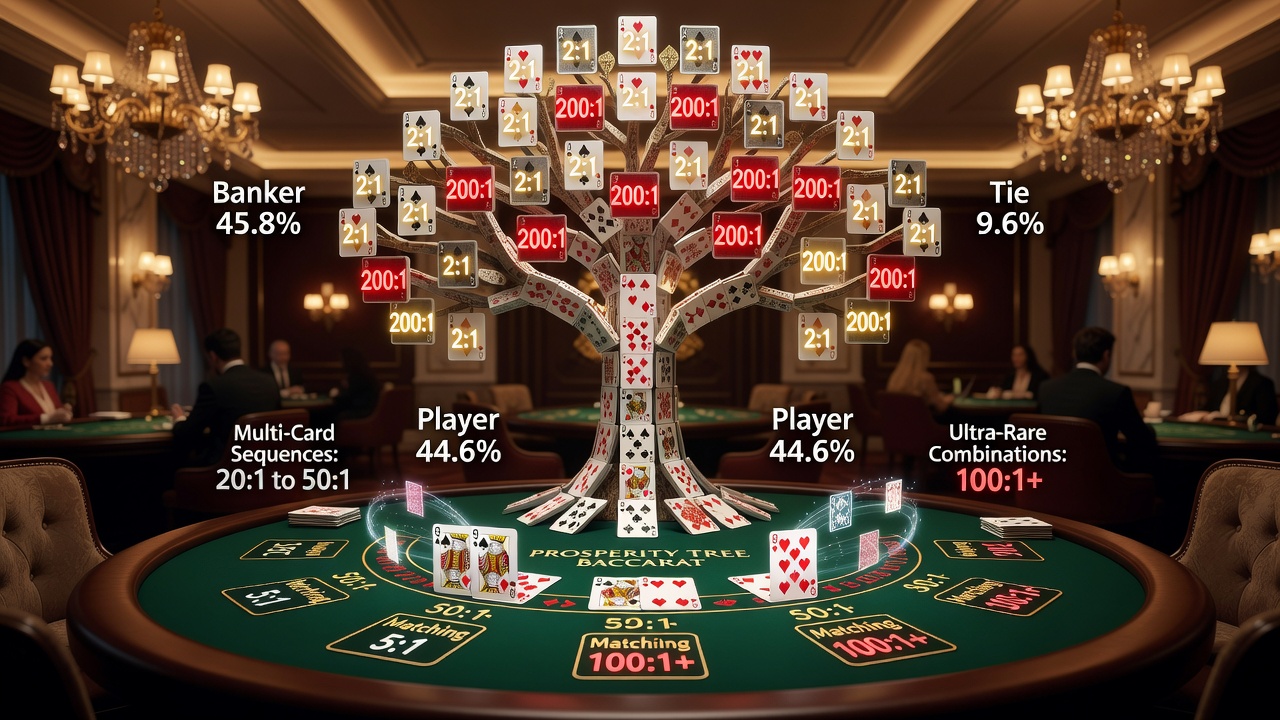
A single side bet with a payout of 200 to 1 sounds like a typo until you check the paytable yourself. That is exactly the kind of number attached to the rarest outcome in Prosperity Tree Baccarat, a variant that takes the oldest card game in the casino and grafts a bonus structure onto it that rewards patience, pattern recognition, and a willingness to bet outside the box.
Traditional baccarat has survived for centuries because it asks almost nothing of the player beyond a decision: Banker, Player, or Tie. Prosperity Tree keeps that simplicity intact but adds a layer of side wagers tied to specific card combinations, transforming a game of near-total chance into one where informed betting choices actually matter. Before placing a single chip, it helps to understand how the odds shift once these extra bets enter the picture - a detailed prosperity tree baccarat review can clarify how the bonus mechanics interact with the base game long before real money is on the table. What follows breaks down the mechanics, the math, and the practical decisions that separate players who understand the game from those who are simply feeding it.
By the end, you will know not just how the game works, but how to approach it with a clear-eyed sense of what the numbers actually support.
What Makes Prosperity Tree Baccarat Different
Prosperity Tree Baccarat builds on standard punto banco rules but introduces a set of side bets themed around a symbolic "tree" that grows prosperity-linked bonuses based on specific card patterns appearing during the hand. The core game - eight decks, natural wins on 8 or 9, third-card draw rules - remains untouched. What changes is the opportunity to wager separately on rare combinations that pay far beyond the standard 1:1 or 8:1 odds seen in classic baccarat.
Core Gameplay Mechanics
Each round follows the familiar sequence: two cards dealt to Player and Banker, a possible third card drawn according to fixed tableau rules, and a winner declared based on which hand is closer to nine. The prosperity tree side bets are wagered before the deal and resolve independently of who wins the main hand, meaning a player can lose the primary bet and still collect a side bonus, or vice versa.
The Symbolic Bonus Theme
The "tree" concept ties visually and mechanically to bonus triggers - certain card ranks or suit combinations "grow" the potential payout multiplier displayed on screen. This isn't cosmetic dressing; it directly maps to the paytable structure governing the side wagers, so understanding the visual cues helps players track which bonus tiers are active during a session.
How It Differs From Standard Punto Banco
Where classic baccarat offers exactly three betting options, Prosperity Tree typically adds four to six additional wagers, each with its own independent odds and payout scale. This expands the decision tree considerably and requires players to budget across multiple bet types rather than committing everything to a single outcome.
Prosperity Tree Baccarat Odds Explained
Odds in this variant operate on two separate tracks. The base game odds mirror standard baccarat almost exactly: Banker wins slightly more often than Player due to the third-card draw rules, and Tie remains a rare, high-variance outcome. The side bets, however, carry dramatically different probability profiles, often ranging from roughly 1-in-20 for the more common bonus triggers to well under 1-in-1000 for the rarest card combinations.
Base Game Probability Breakdown
In an eight-deck shoe, Banker wins approximately 45.8% of hands, Player wins about 44.6%, and Tie accounts for the remaining 9.6%. These figures barely shift from classic baccarat because the underlying deck composition and drawing rules are unchanged.
Side Bet Probability Ranges
Prosperity tree baccarat odds on the bonus wagers depend on which specific pattern is being backed. Bets tied to matching pairs or specific rank combinations occur often enough to keep the payout modest, while bets on rare multi-card sequences carry odds so long that the payout table compensates with triple-digit multipliers.
Why Odds Fluctuate Between Bet Types
The wider the pool of qualifying combinations, the shorter the odds and the smaller the payout. Side bets restricted to a narrow set of card ranks or suits naturally produce lower hit frequency, which is precisely why their payout tables look so much more dramatic on paper.
- Banker win: near 45.8% probability, lowest house edge among main bets
- Player win: near 44.6% probability, slightly higher house edge than Banker
- Tie: near 9.6% probability, highest house edge of the three main bets
- Prosperity side bets: probability varies widely by bonus tier, generally between 1-in-15 and 1-in-800
Prosperity Tree Baccarat Payout Structure
Payout tiers in Prosperity Tree Baccarat are where the game earns its identity. The main bets pay according to familiar baccarat conventions, but the side wagers introduce a scaling structure that rewards rarer combinations with exponentially larger multipliers.
Standard Bet Payouts
Banker bets typically pay 1:1 minus a 5% commission, Player bets pay a flat 1:1, and Tie bets usually pay 8:1, though some tables offer 9:1. These numbers are unchanged from classic baccarat and form the predictable backbone of the game.
Bonus Tier Payout Scaling
The prosperity tree baccarat payout for side bets is tiered, with lower tiers paying somewhere in the 2:1 to 10:1 range for moderately common patterns, mid-tiers reaching into the 20:1 to 50:1 territory, and top-tier combinations - the rarest card sequences - capable of paying well over 100:1.
Reading the Paytable Correctly
Because payout tiers stack by rarity rather than by hand outcome, players need to check the specific paytable posted at their table or within the digital interface before wagering, since minor rule variations between operators can shift payout ratios noticeably at the higher tiers.
Prosperity Tree Baccarat RTP Analysis
Return-to-player figures give the clearest picture of long-term value, and Prosperity Tree Baccarat's RTP splits meaningfully between its main game and its bonus features.
RTP on Main Bets
Banker bets typically return around 98.9% RTP after commission, Player bets sit near 98.6%, and Tie bets drop substantially, often landing between 85% and 88% depending on the exact payout ratio offered. This spread is consistent with virtually every baccarat variant on the market.
RTP on Prosperity Side Bets
Side wagers generally carry a lower prosperity tree baccarat RTP than the main bets, frequently in the 92% to 96% range, because the operator prices in the volatility of large jackpot-style payouts. This tradeoff is standard across bonus-driven table games: higher potential reward comes paired with a thinner long-term return.
Volatility Versus Return Tradeoffs
A lower RTP on a side bet doesn't automatically make it a poor choice - it reflects higher variance, meaning fewer wins overall but larger payouts when they land. Players prioritizing steady bankroll preservation should weight their wagers toward the main game, while those chasing bigger swings can allocate a portion of their budget to the tree bonuses.
Prosperity Tree Baccarat Strategy Tips
No betting system changes the underlying math of a fixed-odds game, but disciplined strategy still separates sustainable play from reckless play. The right prosperity tree baccarat strategy focuses on bankroll allocation, bet selection, and knowing when the side wagers offer genuine value versus when they simply drain the budget faster.
Bankroll Management for Mixed Bet Types
Because this variant tempts players to spread wagers across multiple bet types simultaneously, setting a fixed percentage of the bankroll for side bets - commonly no more than 10% to 15% per session - prevents the higher-variance wagers from eroding funds meant for the more stable main game.
When to Prioritize Main Bets Over Side Bets
Given that Banker carries the lowest house edge in the entire game, building a session around consistent Banker wagers and treating the prosperity side bets as occasional, small supplementary plays tends to preserve bankroll longevity better than the reverse approach.
Avoiding Common Betting Fallacies
Streaks in baccarat, whether on the main hand or the side bonus triggers, are statistically independent events. Chasing a "hot" pattern or doubling down after a bonus miss ignores the fact that each shuffle-adjusted hand carries the same odds as the last, regardless of recent history.
Prosperity Tree Baccarat Bonuses and Promotions
Beyond the in-game side bets, many platforms layer additional prosperity tree baccarat bonuses on top of the base experience, ranging from deposit-matched credits to free-play sessions tied specifically to this variant.
Welcome and Deposit Bonuses
New players are frequently offered matched deposit bonuses that can be applied to baccarat tables, though wagering requirements often exclude or heavily restrict how much Tie or side-bet action counts toward clearing the bonus.
Loyalty and Reload Incentives
Returning players typically gain access to reload bonuses or loyalty points that accumulate based on total wagered volume, which can meaningfully offset the house edge over time if redeemed consistently rather than left unused.
Reading Bonus Terms Before Claiming
Wagering requirements, maximum bet caps while a bonus is active, and game-weighting rules all affect how much practical value a promotion delivers. A bonus that looks generous on the surface can carry restrictions that make it nearly impossible to extract real value from a baccarat table specifically.
Frequently Asked Questions
Is Prosperity Tree Baccarat harder to learn than classic baccarat?
No. The core rules of dealing, drawing, and determining a winner are identical to standard baccarat. The only additional learning curve involves understanding the side bet paytable and how the bonus tiers trigger.
Do the side bets affect the odds of the main Banker or Player bet?
No. The prosperity tree side bets resolve independently and have no influence on the probability of Banker, Player, or Tie winning the main hand. They are separate wagers layered on top of an unchanged base game.
What is a realistic bankroll approach for a beginner?
Start by allocating the vast majority of your session bankroll to Banker bets, since they carry the lowest house edge, and cap side-bet spending at a small, predetermined percentage to limit variance while you learn the paytable.
Are the highest-paying side bets worth the risk?
They can be, depending on your risk tolerance. The rarest combinations pay significantly more but hit far less often, so they suit players comfortable with long losing stretches in exchange for occasional large payouts rather than those seeking steady, incremental returns.
How often do payout tables differ between casinos offering this game?
Payout ratios on side bets can vary noticeably between operators, even when the base game rules stay consistent. Always check the posted paytable at your specific table before wagering, since a seemingly small difference in payout ratio can meaningfully shift the effective RTP.
Can bonus promotions realistically improve long-term results?
Yes, but only if the wagering requirements are reasonable and baccarat is fully weighted toward clearing them. Many promotions heavily restrict or exclude baccarat play from bonus contribution, so it's worth confirming this detail before assuming a promotion adds real value to your sessions.