
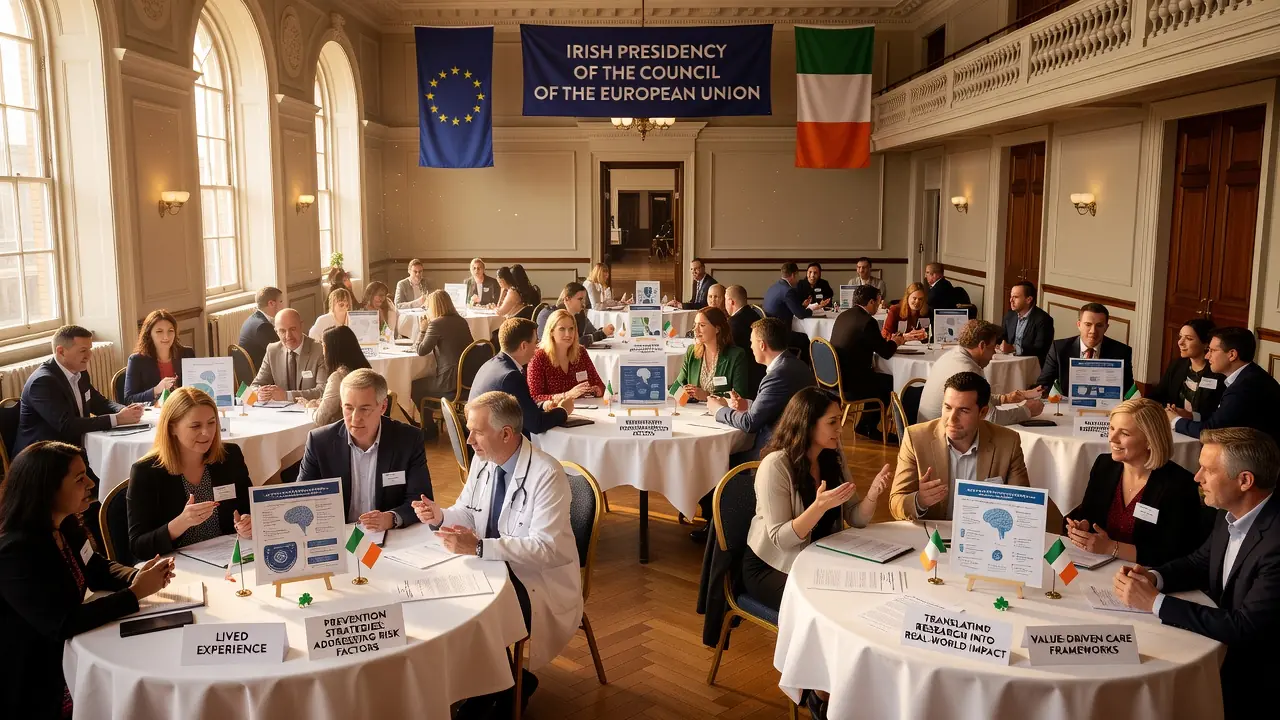
A new kind of policy gathering is being organised in Ireland under the banner "A Value-Driven Future for Brain Health & Care", an interactive Policy World Café designed to put people with lived experience of brain conditions, carers, clinicians, researchers, policymakers, funders and industry representatives around the same table. The event unfolds against the backdrop of the Irish Presidency of the Council of the European Union, lending it a platform beyond the national level. Its stated aim is practical: move a scattered conversation about brain health into a set of recommendations that can actually travel into policy.
Why a World Café format matters
The World Café method is built on structured, small-group dialogue rather than panel presentations and keynote speeches. Participants rotate through facilitated discussions, each focused on a distinct challenge, so that ideas accumulate and cross-pollinate rather than staying siloed within a single professional group. For a field as fragmented as brain health - spanning neurology, psychiatry, dementia care, stroke recovery and mental health services - this structure is a deliberate choice. It forces clinicians to hear directly from carers, and funders to sit alongside people living with a condition, rather than receiving their input secondhand through surveys or advocacy reports.
Four challenges, one shared agenda
The session is organised around four themes: lived experience, prevention, translating research into real-world impact, and value-driven care. Each has its own logic. Lived experience foregrounds the perspective of patients and carers who navigate fragmented services daily. Prevention addresses the structural and lifestyle factors that influence brain health long before a diagnosis is made. Research-to-impact confronts a familiar problem in healthcare policy: promising findings that stall before reaching patients because of funding gaps, regulatory complexity or weak implementation pathways. Value-driven care asks how health systems define and measure success - not simply in clinical outcomes, but in terms meaningful to patients and sustainable for strained public budgets.
- Lived experience and carer input as a formal input into policy design, not an afterthought
- Prevention strategies addressing risk factors before diagnosis
- Faster, more coordinated translation of research into clinical and community practice
- Value-based frameworks that weigh cost, outcome and patient priority together
From dialogue to a closing policy session
What distinguishes this event from a typical conference is the intention to feed outputs directly into a closing policy dialogue. Rather than producing a report that circulates quietly after the fact, organisers describe a process where recommendations generated in the café sessions are carried, in close to real time, into a discussion involving decision-makers. This reflects a broader shift in European health policy circles: a growing preference for participatory formats over top-down consultation, partly in response to criticism that patient and carer voices are too often consulted late, if at all, in shaping health strategy.
Why it matters for health-system resilience
Brain health conditions - including dementia, stroke, depression and neurodevelopmental disorders - represent a growing share of healthcare demand across Europe as populations age. Fragmented care pathways, uneven access to specialists, and siloed research funding all contribute to inefficiencies that a more coordinated, people-centred approach could address. Positioning this event within the Irish EU Presidency signals an attempt to connect national-level initiative with the wider European policy architecture, where coordination between member states on health system resilience remains an ongoing and unfinished project rather than a solved problem.