
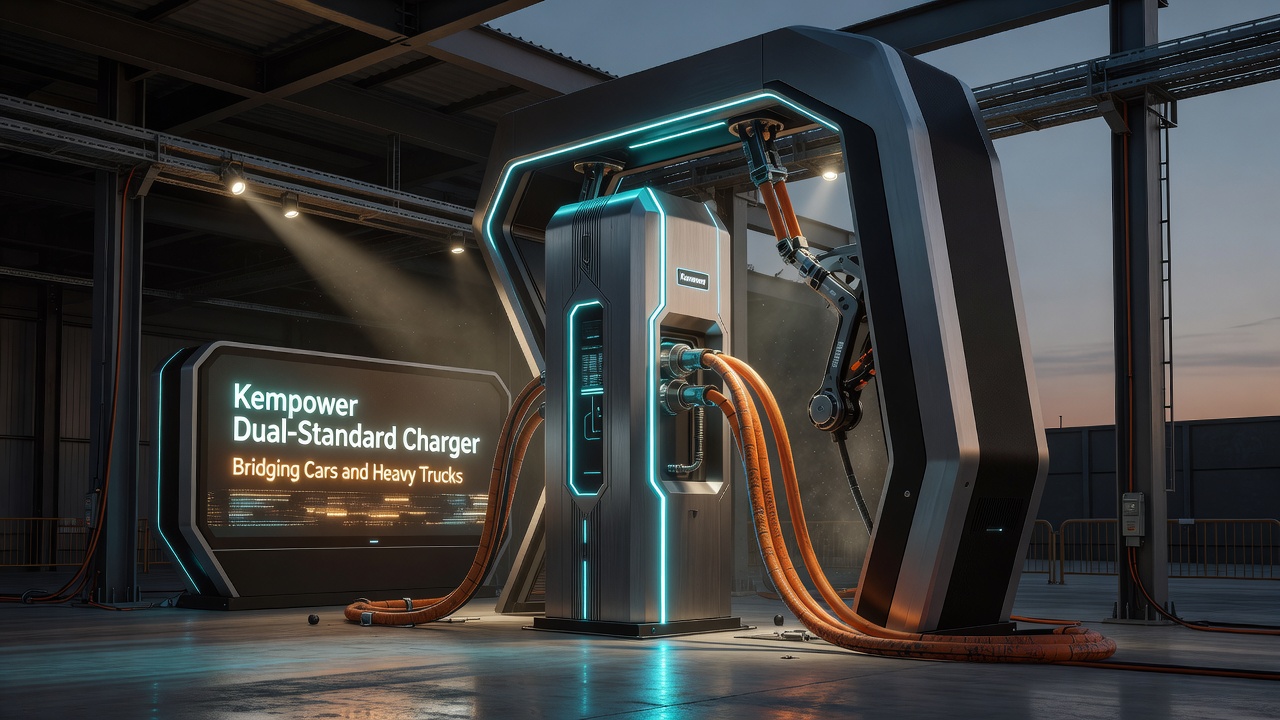
Kempower has introduced the Mega Satellite Flex, a charging unit built to serve both passenger electric vehicles and heavy-duty trucks from a single piece of hardware. The device supports the established CCS standard at up to 560 kW and the emerging Megawatt Charging System at up to 1.2 MW, making it the company's first dispenser capable of switching between the two. The announcement came this week at the Unplug & Recharge event held alongside ACT Expo, where the charger is on display for operators and fleet partners.
Why One Charger for Two Vehicle Classes Matters
The electric vehicle charging industry is at an awkward midpoint. CCS remains the dominant standard for cars, vans, and light commercial vehicles, while MCS is only beginning to reach the infrastructure stage needed for long-haul electric trucks, which require far more power to make sense for logistics operators. Building separate sites for each standard is expensive and slow, and it risks leaving land and grid capacity underused while demand for one vehicle type outpaces the other. A charger that handles both from day one lets site owners hedge against that uncertainty rather than betting on a single technology path. It's also worth noting that charging speed itself is a moving target across vehicle types, much the way how much a VPN slows down your connection depends on the protocol and hardware involved rather than a fixed number - the real-world result varies with battery architecture, cable specifications, and site power management.
The Technical Details Behind the Flexibility
The Mega Satellite Flex is rated for up to 1,500 amps on the MCS side and 700 amps for CCS, with cable lengths of 5 meters for CCS connections and 2.7 meters for MCS. That amperage range is what allows the unit to serve both a passenger sedan topping up quickly and a heavy truck drawing power at a scale closer to what a small building might need. The charger also supports 800-volt vehicle architectures, an increasingly common design in newer EVs that allows for shorter charging sessions when paired with sufficiently powerful equipment. An optional payment terminal can be built into the unit, a detail aimed squarely at public charging operators who need to serve occasional retail customers rather than only fleet accounts.
Fitting Into Existing Charging Networks
Kempower designed the Flex to work within its existing distributed charging architecture, meaning operators who already run Kempower systems can add the new unit without redesigning their electrical layout or replacing other equipment. That compatibility matters more than it might seem: distributed charging systems separate the power conversion hardware from the dispenser itself, which allows a site to add or reconfigure charging points as demand shifts without rebuilding from the ground up. For an operator uncertain whether the next surge in demand will come from electric trucks or higher-powered passenger vehicles, that flexibility reduces the financial risk of guessing wrong.
What Comes Next
Kempower expects the Mega Satellite Flex to reach the North American and European markets in July 2026, giving fleet operators and charging network developers over a year to plan deployments around it. The timing lines up with the broader rollout of MCS-capable trucks from several manufacturers, suggesting the charger is meant to be ready roughly when truck volumes justify the investment. Whether the dual-standard approach becomes the industry norm or remains one option among several will likely depend on how quickly MCS infrastructure standards solidify and how fast truck makers commit to the technology at scale.