
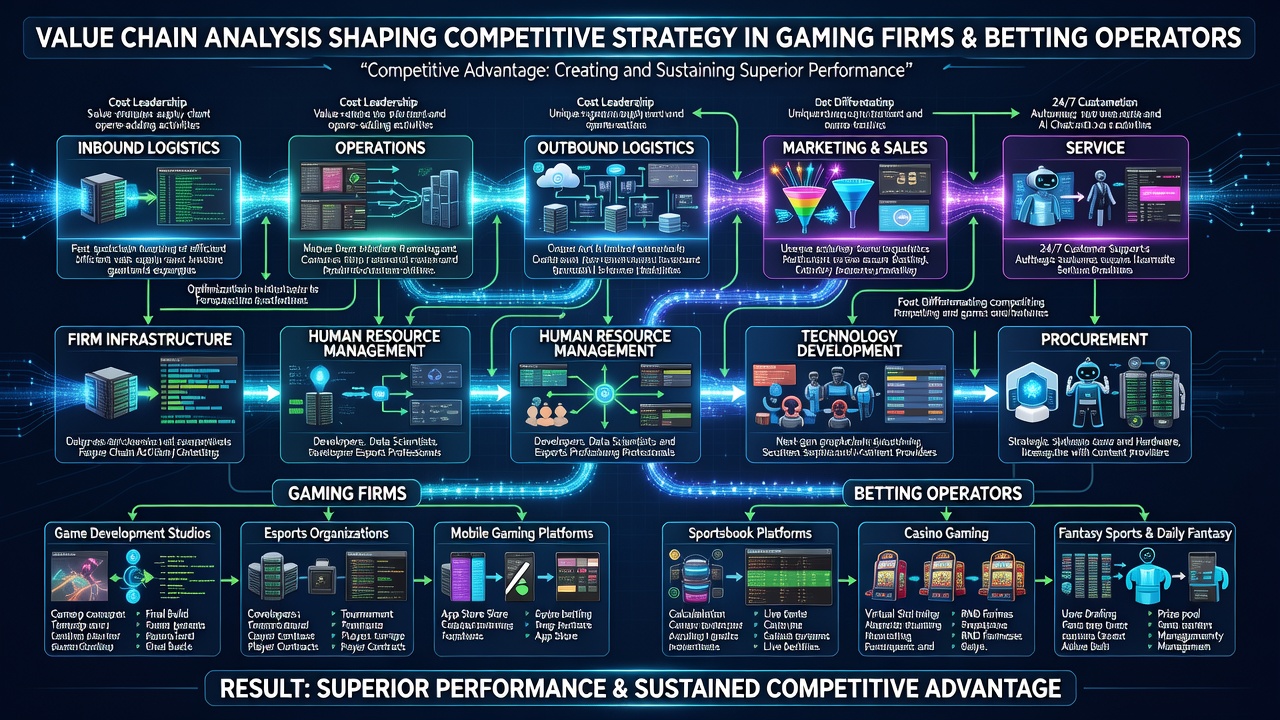
Every product a consumer buys, whether a bag of groceries or a wager placed through a mobile app, passes through a sequence of activities that build its worth before it ever reaches the buyer. That sequence is what Michael Porter, writing in "Competitive Advantage: Creating and Sustaining Superior Performance," termed the value chain. The concept has quietly become a standard lens through which operators across industries, including gambling and digital entertainment, assess where they are efficient and where they are bleeding money.
What the Value Chain Actually Measures
Porter's insight was that competitive advantage does not come from a company as a single entity. It comes from discrete steps: inbound logistics, operations, outbound logistics, marketing and sales, and service. Each of these primary activities is supported by procurement, technology development, human resources management, and infrastructure. A firm that sharpens any one of these links can lower costs, raise quality, or both, and that combination is what ultimately separates a market leader from a company that merely survives.
The goal is not complexity for its own sake. It is to deliver the greatest value at the lowest cost, creating room to outprice or outperform rivals without eroding margins.
Why This Matters for Betting and Gaming Operators
Apply the same framework to a betting platform or online casino and the parallels are direct. Inbound logistics becomes data sourcing and game or odds supply from content providers. Operations covers platform uptime, in-house product development, and how quickly new markets or titles go live. Outbound logistics translates into how a customer experiences the product: app speed, payment processing, withdrawal times. Marketing and sales involves advertising, promotional offers, and customer acquisition strategy, all of which now sit under far heavier regulatory scrutiny than in most retail sectors. Service, in this context, means customer support, dispute resolution, and responsible gambling tools such as deposit limits, self-exclusion, and session reminders.
Support activities matter just as much. Procurement determines which software providers and payment processors a platform works with. Technology development governs fraud detection, age verification, and the security of personal data. Human resources shapes whether compliance teams are adequately staffed to keep pace with shifting licensing requirements. Infrastructure, including risk management and financial controls, determines whether an operator can demonstrate to a regulator that player funds and data are properly safeguarded.
Efficiency Cannot Come at the Expense of Oversight
Where value chain thinking becomes genuinely useful in this sector is in exposing trade-offs. A company might streamline onboarding to reduce friction for new customers, but if identity verification and affordability checks are weakened in the process, the efficiency gain creates regulatory and consumer-protection risk. Similarly, aggressive marketing spend might boost short-term acquisition numbers while increasing exposure to advertising rules designed to protect vulnerable users.
Value chain analysis, properly applied, forces a business to look at costs and benefits at each stage rather than only at the bottom line. For regulators and consumers alike, that discipline is useful: it means decisions about pricing, promotions, and customer service are made with visibility into their full downstream effects, not in isolation.
A Broader Business Discipline, Not a Gambling-Specific Tool
The value chain model was never designed with betting or casino products in mind, which is precisely why it travels well across sectors. It applies equally to a grocery chain refining its private-label strategy and to a gaming operator weighing how much to invest in compliance infrastructure versus customer acquisition. Understanding where value is created, and where it is quietly destroyed by inefficiency or unmanaged risk, remains one of the more durable tools in business strategy, regardless of the industry applying it.