
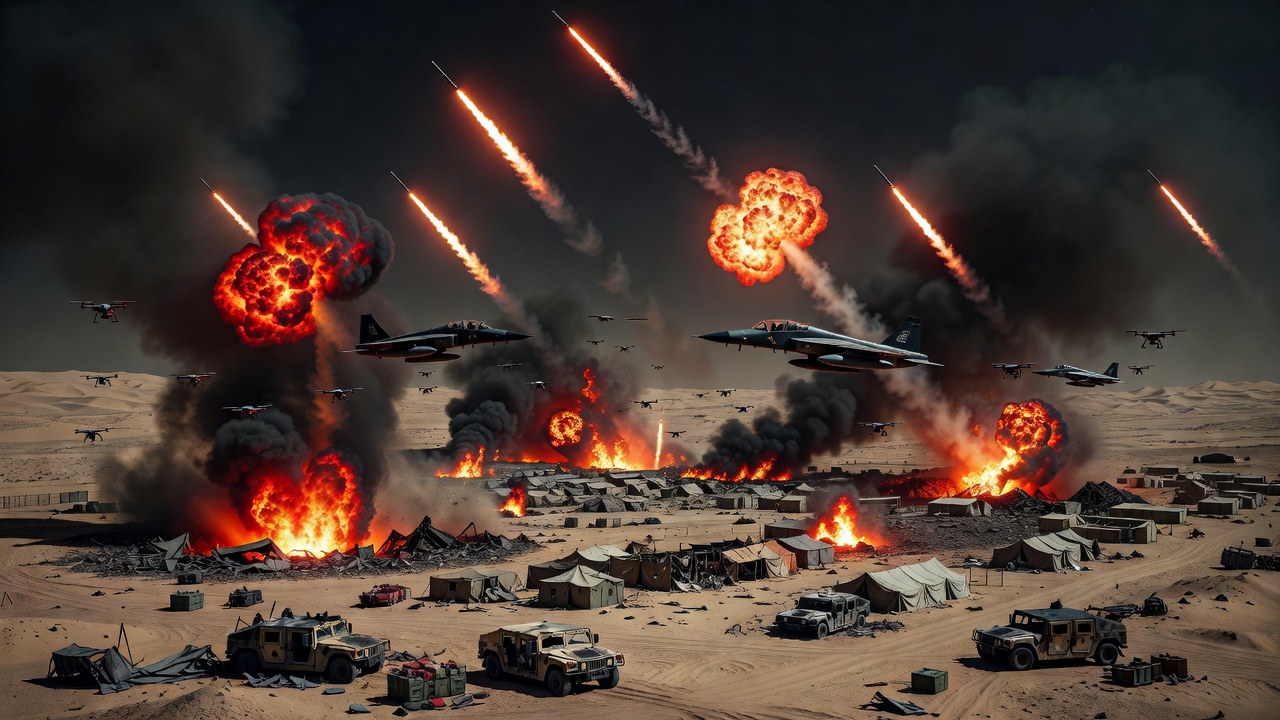
Video obtained exclusively by CBS News documents Iranian missile, drone and fighter jet attacks on Camp Buehring, a major American staging base in Kuwait, during the opening days of a war that began seven months ago. The footage, recorded by someone stationed on the ground, shows explosions, structural damage and wrecked equipment - offering the clearest visual record yet of how exposed U.S. forces were in the conflict's early hours.
What the footage shows
The videos capture ballistic missile strikes, drone attacks and, according to witnesses, runs by Iranian F-5 fighter jets low enough that soldiers could see the pilots' helmets. CBS News says it authenticated the material through embedded metadata and by cross-referencing it with separate photographs of damage at the base. Camp Buehring sits roughly 25 miles from the Iraqi border and has functioned for more than two decades as a key staging ground for American deployments across the Middle East.
A base stretched thin
Before the war began, the Pentagon had already moved most of the roughly 7,000 troops normally at Camp Buehring elsewhere, part of what officials call the "get off the X" strategy - repositioning forces away from predictable, vulnerable locations. Defense Secretary Pete Hegseth has said more than 90% of American personnel on regional bases were relocated out of range of Iranian fire as offensive operations built up.
But more than 100 soldiers remained at Camp Buehring once the strikes started, and sources describe a base that struggled to cope. Troops reportedly ran critically low on .50-caliber ammunition, and a senior Army logistics official confirmed concerns about the availability of that ammunition and other high-value systems such as Patriot missile batteries. One source described the base as having been "demolished" and questioned why reinforcements never arrived.
Retreat into the desert
Facing continued bombardment, soldiers eventually loaded vehicles with whatever equipment they could carry and drove at night into the Udari Desert, establishing makeshift forward operating bases. Conditions there brought their own dangers: two soldiers were struck by lightning during sandstorms in late April, one suffering burns and the other a ruptured eardrum, according to officials familiar with the incidents. Army leaders had reportedly been trying to move troops out of the area before the lightning strike but could not do so in time. The soldiers eventually relocated to Camp Arifjan in May before redeploying elsewhere.
The broader toll
No American service members were killed by enemy fire at Camp Buehring or the improvised desert positions, but the episode fits into a wider pattern of damage documented since the war began. The Pentagon inspector general has reported equipment losses of up to $3.7 billion, including nearly 60 aircraft, while the Congressional Research Service puts total aircraft and drone losses or damage at 81 since February. Iranian strikes were also reported at U.S. bases in Bahrain, Qatar, the UAE, Saudi Arabia, Iraq, Oman and Jordan, and CBS News has separately documented the war's deadliest attack on American troops, a strike on the Port of Shuaiba that killed six service members.
U.S. Central Command declined to comment on the Camp Buehring footage, and the Pentagon referred only to Hegseth's earlier public remarks - leaving many of the operational details, including why reinforcements did not reach the base, unanswered for now.