
Sports betting has grown into a layered consumer product, and the wagers themselves have grown just as complex as the odds compilers who price them. Beneath the familiar win-draw-win market sits a wider set of options - over/under, handicap and both teams to score among them - each built on a different logic for how risk and reward are structured. Understanding that logic matters more than it might first appear, because the market a bettor chooses shapes both the probability of success and the kind of information that is actually relevant to the decision.
Totals Markets Shift Focus Away From the Winner
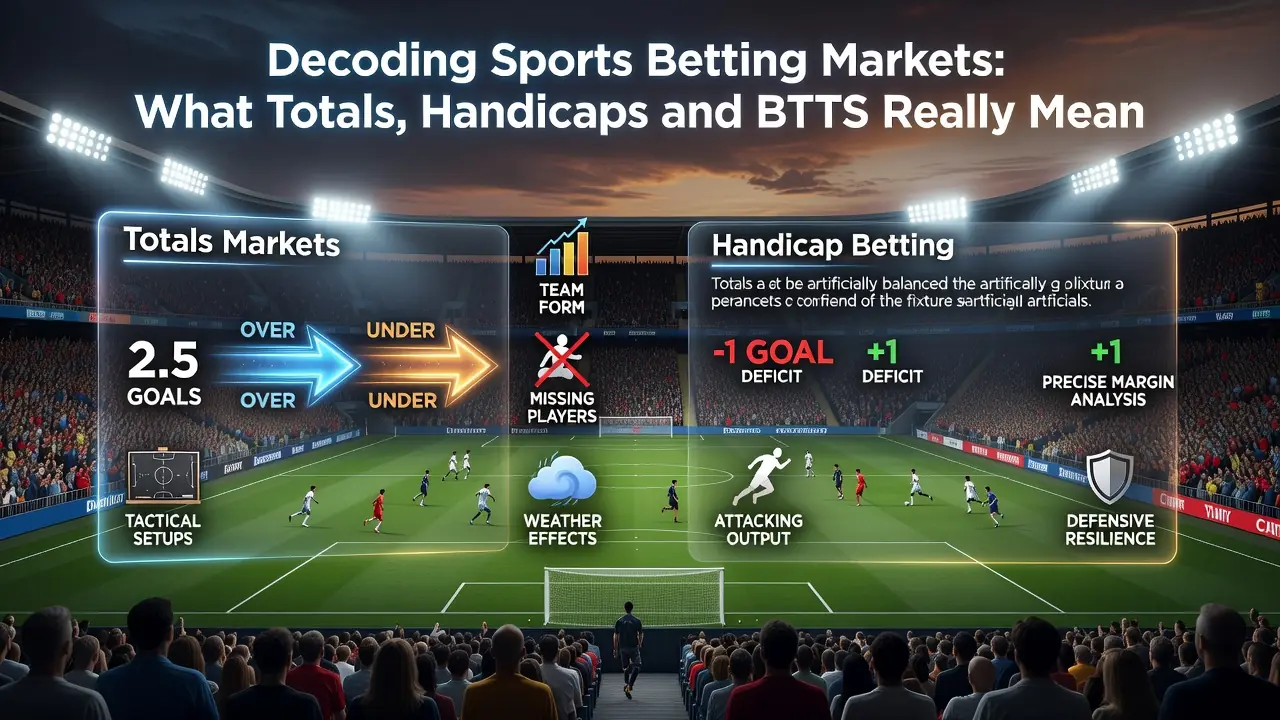
Over/under betting, sometimes called totals, removes the need to pick a winning team altogether. Instead, the bookmaker sets a numerical line - commonly a figure like 2.5 goals in football - and the bettor predicts whether the combined score will land above or below it. Because half-numbers are typically used, a definitive outcome is guaranteed one way or the other.
This structure appeals to bettors who want to assess the overall tempo of a contest rather than its result. Team form, missing players, tactical setups and even weather can influence scoring patterns, and all of that becomes relevant when evaluating a totals line. It is a market that rewards attention to context rather than simple allegiance to a favourite.
Handicap Betting Rebalances Mismatched Fixtures
Handicap markets exist because many fixtures are not competitive in a strict sporting sense. A heavy favourite might be artificially assigned a -1 goal deficit before kick-off, while the underdog receives a corresponding +1 advantage. A bet on the favourite only succeeds if that team wins by enough to overcome the handicap; a bet on the underdog can succeed even in defeat, provided the margin stays within the handicap line.
This mechanism is essentially a way of pricing in perceived quality differences, and it is one reason handicap markets are popular in sports with frequent lopsided matchups. For bettors, it forces a more precise judgement: not just who wins, but by how much - a distinction that demands closer analysis of attacking output and defensive resilience rather than reputation alone.
Both Teams to Score Tests Attacking and Defensive Balance
The BTTS market is binary and relatively easy to state: a “yes” bet wins if both sides score at least once, a “no” bet wins if either side fails to. Its simplicity is deceptive, though, because assessing it properly requires weighing two opposing forces at once - the attacking capability of both teams and the defensive solidity each brings into the match. A team with strong forwards can still be shut out against a well-organised defence, which is why head-to-head history and recent defensive records tend to carry particular weight in this market.
Research and Risk Management Matter More Than Market Choice
No betting market changes the underlying mathematics of bookmaker margins or house edge, and none of them offer a reliable route to consistent profit. What they do offer is a way to apply more targeted analysis to a match. A few practices are widely regarded as sound discipline rather than strategy for beating the odds:
- Reviewing team and player statistics from credible, up-to-date sources before committing to a bet
- Setting a fixed budget for betting activity and treating it as discretionary spending, not investment capital
- Comparing odds across licensed operators, since pricing on the same market can vary
- Approaching in-play or live betting with the same discipline as pre-match betting, given its faster pace
- Keeping a record of past bets to understand personal patterns and tendencies over time
These habits do not change the fact that betting outcomes remain uncertain by design. They do, however, help bettors engage with markets like totals, handicaps and BTTS in a more informed and controlled way - treating each wager as a calculated decision rather than a guess, and keeping gambling firmly in the category of entertainment rather than income.